
Join the ETIP HYDROPOWER general assembly to receive news about our activities, events and research & innovation in hydropower opportunities.
Join Us
The International Hydropower Association (IHA) recently released a blog titled "Drought Management: The Functions of Hydropower." While climate change projections suggest increased risks for hydropower as temperatures rise, the blog emphasizes the unique role hydropower infrastructure can play in mitigating drought impacts.
According to the IHA, even though droughts can affect hydropower generation, reservoirs associated with these projects offer crucial capabilities:
The blog highlights the economic significance of hydropower's role in drought mitigation. Moreover, a previous assessment estimated the combined annual economic benefits of hydropower's flood and drought control functions globally at a staggering 314.88 billion USD, representing 0.35% of global GDP.
To learn more about the drought mitigation capabilities of hydropower, you can read the full IHA blog post here.
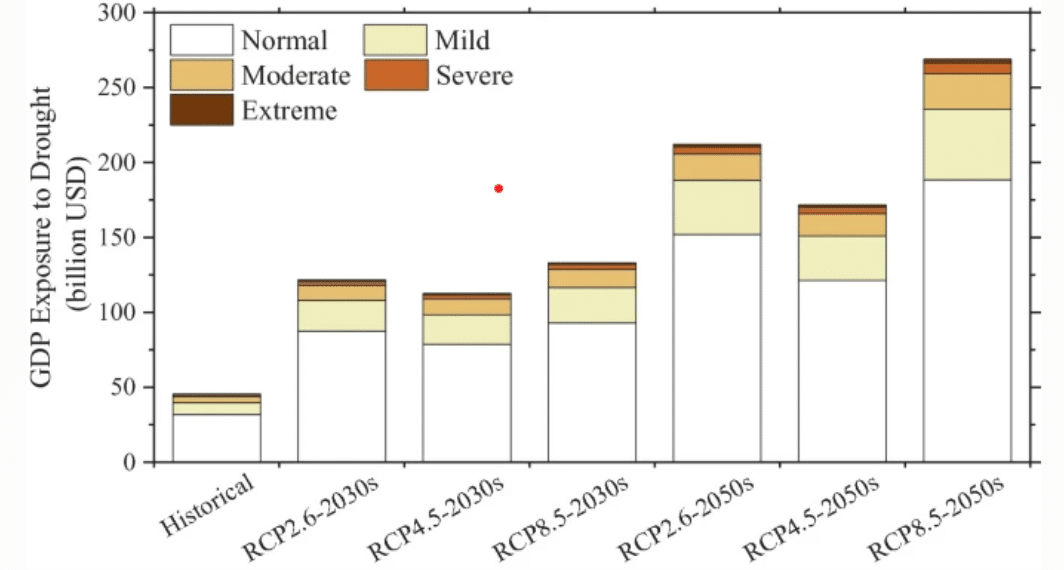
Figure - Global GDP exposure to droughts for the historical period and the 2030s and 2050s under different climate scenarios. Taken from Sun et al. (2022).